BytesGlue
LicenseSeal logoLicenseSealIn development

Licensing & entitlement infrastructure

Put the rules around your software. Keep the experience usable.

LicenseSeal is being developed for publishers who need activations, seats, plans and feature access across connected and offline environments. Its approach separates policy and entitlement management from runtime enforcement, so the product team can design the commercial model without hiding the operational rules in every application.

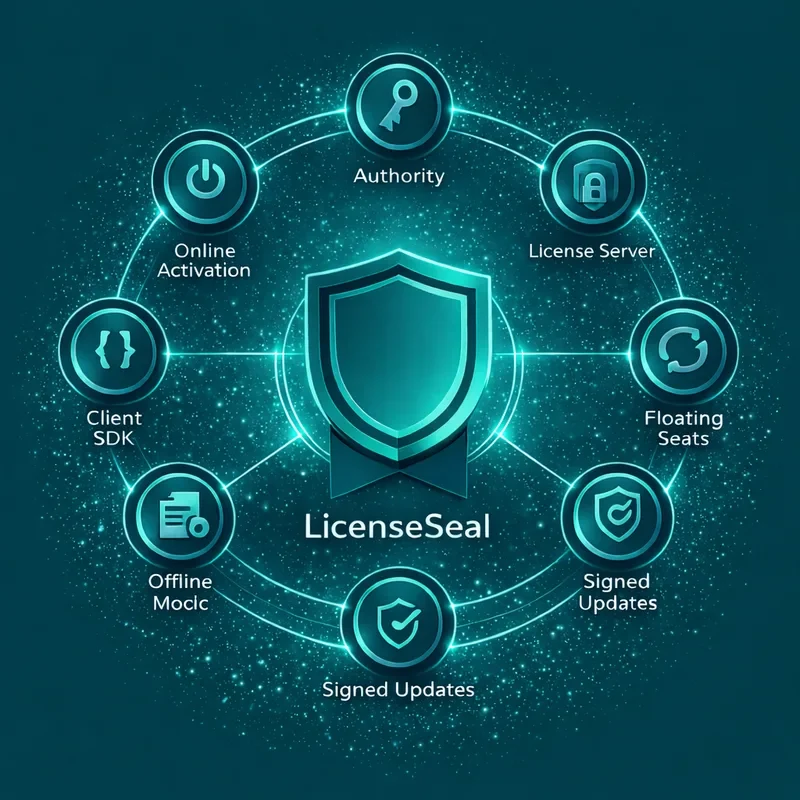
LicenseSeal official product illustration
From the LicenseSeal product website
  • Software publishers
  • Desktop application teams
  • Enterprise software vendors
  • Connected & isolated deployments

The work it helps you do

Built around the way you operate.

Explore the workflows behind LicenseSeal, from everyday details to the bigger picture.

01

Define what a customer can use

Describe products, plans and feature access in a central licensing policy instead of scattering rules through the application. Entitlements connect a licence to the capabilities a product should expose. Different packaging models let a publisher distinguish plans, features and usage allowances without treating them as the same thing.

02

Control activation and device relationships

Activation records connect an issued licence to runtime use. Node-locked models associate access with an installation or device; seat-based models govern concurrent users or instances. Recovery and replacement workflows matter as much as enforcement, especially when support staff need to understand what happened after a customer changes a machine.

03

Plan for offline environments

Some customers cannot keep software connected to a licensing service. The design includes signed licence material and offline validation alongside connected checks. Publishers choose expiry, verification and recovery rules. Air-gapped or intermittently connected installations need these decisions during integration, rather than as an exception after the application has shipped.

04

Manage floating seats and leases

A floating model tracks occupied seats and makes them available when sessions finish or leases expire. Lease and recovery behaviour affect both licence protection and the user’s ability to return to work. Explicit seat controls distinguish a valid reservation, active use and the conditions for releasing access.

05

Make trust and signing deliberate

Signed tokens and trust material support verification in the client and runtime server. Key rotation, server-side signing responsibilities and audit information belong to the design. SDK integration should verify the material it receives and handle agreed failure states. Security and deployment review remain part of engineering the complete solution.

06

Fit licensing into product operations

APIs, SDK integration, activation history and operational controls connect licensing to commercial and support workflows. SaaS, hybrid and self-hosted deployment are part of the intended architecture. LicenseSeal remains in development: confirm the supported runtime, readiness and integration scope before relying on it for a production rollout.
See the product

A closer look at LicenseSeal.

Original product visuals from the official website, showing the workflows and ideas behind the product.

Your next steps

Start with the workflow that matters.

  1. Describe the commercial model

    List products, plans, features and seat rules. Decide how device changes, renewals, offline use and support should work before selecting enforcement policy.

  2. Map the integration boundary

    Identify where the application activates, validates and handles licence changes. Review SDK, deployment, trust material and recovery requirements with the product team.

  3. Evaluate a representative scenario

    Test connected and offline validation, seat use and failure handling within an agreed scope. Confirm development readiness before committing a customer-facing dependency.

شروع کرنے سے پہلے

A few useful answers.

Need help choosing the right setup?

Talk to the team →
Is it a finished product?

LicenseSeal is in development. The website describes its direction; readiness and integration scope need confirmation before a production commitment.

Can it cover offline applications?

Offline licensing is part of the design through signed material and validation rules. Review runtime, offline duration and recovery requirements for your application.

How do node-locked and floating differ?

Node-locked access is tied to an installation or device. Floating access manages a shared seat pool through leases and release rules.

Must I replace my checkout?

Licensing and payment are separate concerns. Discuss entitlement creation and changes alongside your existing checkout; a plan name does not imply a payment-provider integration.

Take the next step

See what LicenseSeal can do for you.

Explore the product, review its current plans and find the workflow that fits your team.

Customer support ہم سے بات کریں